
My first startup had 100% week-over-week growth
Technically, it was my second startup.

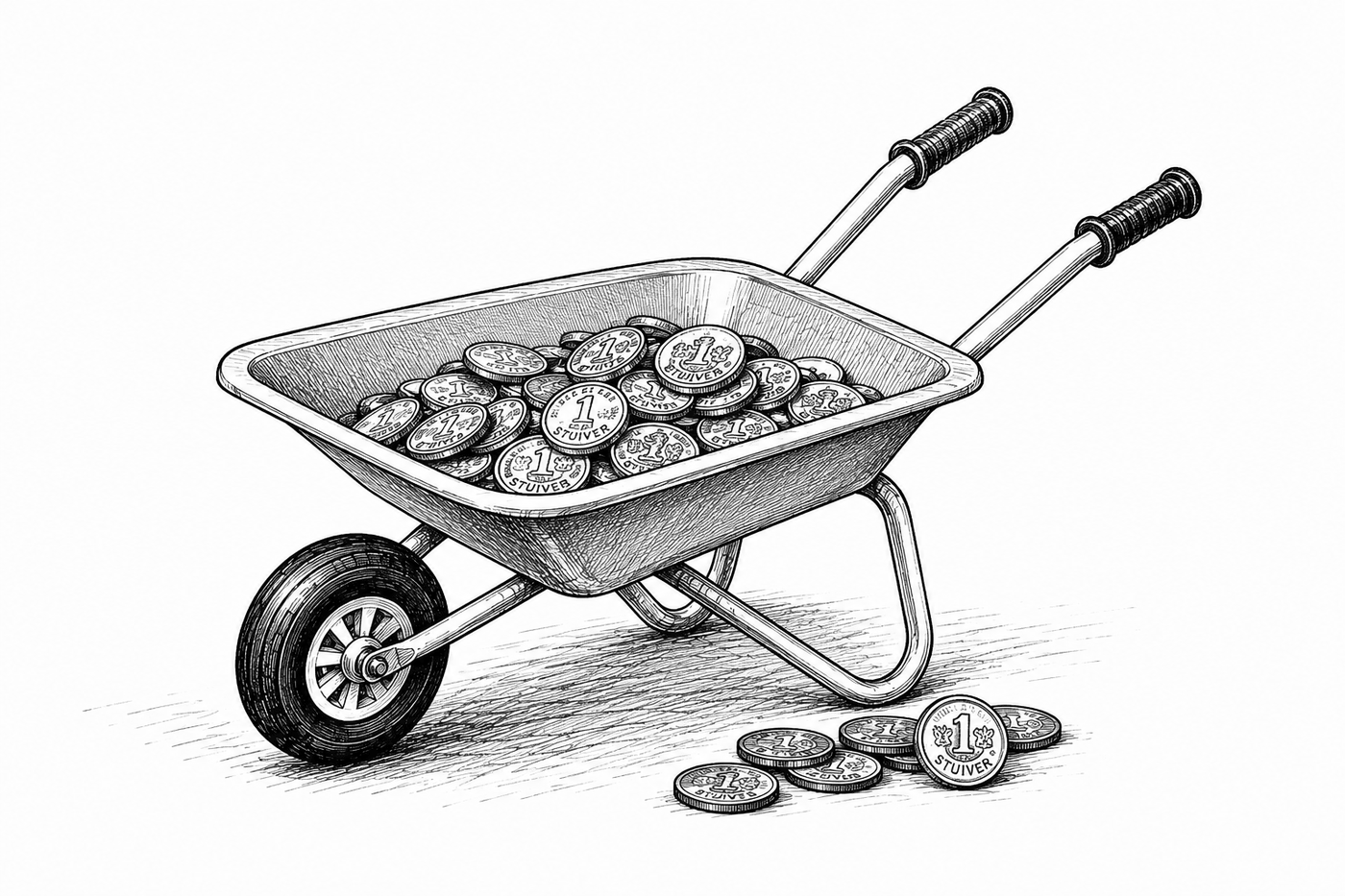
My first was launched when I was nine years old, shortly before the Netherlands replaced the guilder with the euro. I had seen a story about a man who had spent more than a decade filling a large cartwheel with pennies. I did not have a decade, and the cartwheel I had was considerably smaller, but I did have access to an entire village full of people whose small change was about to become obsolete. So I started going door to door collecting stuivers.
Customer engagement was surprisingly strong. People did not merely hand over the coins they happened to have lying around. Some started saving their stuivers specifically for me, so I could return the following week and collect them. I had recurring supply, strong local awareness and, eventually, earned media. A photographer came to document the venture for the local press, although I still need to ask my mother whether the picture has survived.
The cartwheel filled up reasonably well. I used the proceeds to buy Lego, as every nine-year-old entrepreneur should.
My second startup came in 2015, when I was a student in Groningen. It was the sort of beginning you often hear about in founder stories, but never really expect to experience yourself. I launched the company and signed three customers in the first week. They were extremely enthusiastic about the product and immediately started sharing their experiences with others. Those people joined too, told their friends and brought in another group. For several weeks, the company grew approximately 100% week over week.
Customer acquisition was entirely organic. We spent nothing on advertising, had no sales team and did not need an elaborate website. The customers effectively became the distribution channel, and the community grew through word of mouth. Retention was exceptional. Once people joined, many of them continued using the product every week. There was very little churn and the customers who stayed became increasingly engaged.
The unit economics were equally compelling. Gross margins comfortably exceeded 90%, fixed costs were almost nonexistent and customer service could be handled through a lightweight mobile interface. There were no expensive systems, no office and barely any operational infrastructure. I was simultaneously the founder, primary service provider, account manager and community lead, but the workload remained manageable because most communication took place through WhatsApp.
At some point, I discovered a simple way to double ARPU. Rather than finding an entirely new customer segment or launching a complicated premium product, I increased the frequency with which existing customers could use the service. The customers were already engaged, the demand was clearly there and the additional delivery costs were limited, so the change had an almost immediate effect.
Before long, more than 50 people were part of the community. Demand began to exceed my own delivery capacity, which meant I had to recruit other people to run sessions and ensure that the customer experience remained consistent. What had started as a small founder-led operation was slowly developing into a decentralised delivery model, with other operators able to serve the customer base while I coordinated the wider community.
It was a capital-efficient, community-led company with organic acquisition, extraordinary retention, high margins, recurring revenue and the beginnings of a scalable operational model.
Here’s the twist. It was a bootcamp club.
The first three customers were friends of mine. The product was exercise in a park. The supposedly lightweight mobile interface was a WhatsApp group, and people paid me five euros in cash every time they joined a training. My brilliant ARPU expansion strategy was to add a second session each week. The decentralised operating model meant asking other energetic people to lead groups of students through squats, sprints and burpees when I could no longer run the whole group by myself.
None of the earlier description is false. That is what makes it interesting. The same underlying business can sound fundamentally different depending on which information you emphasise, which information you omit and which language you use. Three customers becoming six represents 100% growth, just as three million customers becoming six million does. Gross margins above 90% sound exceptional until you realise that the main input was a student standing in a field, shouting at other students to run faster. Doubling ARPU sounds like a sophisticated pricing strategy until you learn that it meant organising bootcamp twice a week instead of once.
Percentages become especially powerful when separated from their denominators. So do phrases such as viral acquisition, customer obsession, community-led growth and operational leverage. They are not necessarily wrong, but they can trigger conclusions that the underlying facts do not justify. We hear that a business is growing 100% week over week and imagine acceleration. We hear that it has exceptional retention and imagine an indispensable product. We hear that the founder has doubled ARPU and imagine a sophisticated understanding of pricing and customer segmentation. Sometimes all of that is true. Sometimes a handful of students simply enjoy exercising together in a park.
This is not only something founders do to investors. Investors do it to their LPs, journalists do it to their readers and entire industries do it to themselves. A small number becomes a growth rate, a group chat becomes a community platform and someone helping out for an evening becomes evidence that the operating model can scale. With enough abstraction, almost any functioning activity can be made to resemble a venture-backed company.
Had I started the bootcamp today, I could probably have described it as a social fitness platform built around accountability and local community. Friends inviting friends might have been presented as a network effect. The WhatsApp group could have become a proprietary engagement layer. Other trainers leading sessions might have been framed as the start of an asset-light instructor marketplace. I could have announced plans to expand into other university cities and perhaps even raised a pre-seed round to build the app that nobody had asked for.
Instead, I quit. There was no dramatic collapse, no sudden churn and no better-funded competitor entering the Groningen bootcamp market. I simply stopped enjoying it. What had started as a nice way to make some money while exercising had become an obligation, and the workout itself had become less enjoyable for me.
So I handed the WhatsApp admin rights to someone else and stopped running the sessions. I believe the bootcamp club may still exist today, which means that my second startup technically had 100% week-over-week growth, extraordinary retention, more than 90% gross margins and a successful founder exit.
My first had recurring supply, engaged contributors, organic word of mouth and local press coverage during a once-in-a-generation currency transition. Its proceeds were reinvested into Lego.
Looking back, my entrepreneurial career may have peaked at nine.
And this is why I love you