
Who Picks First
What is being active even a proxy for?

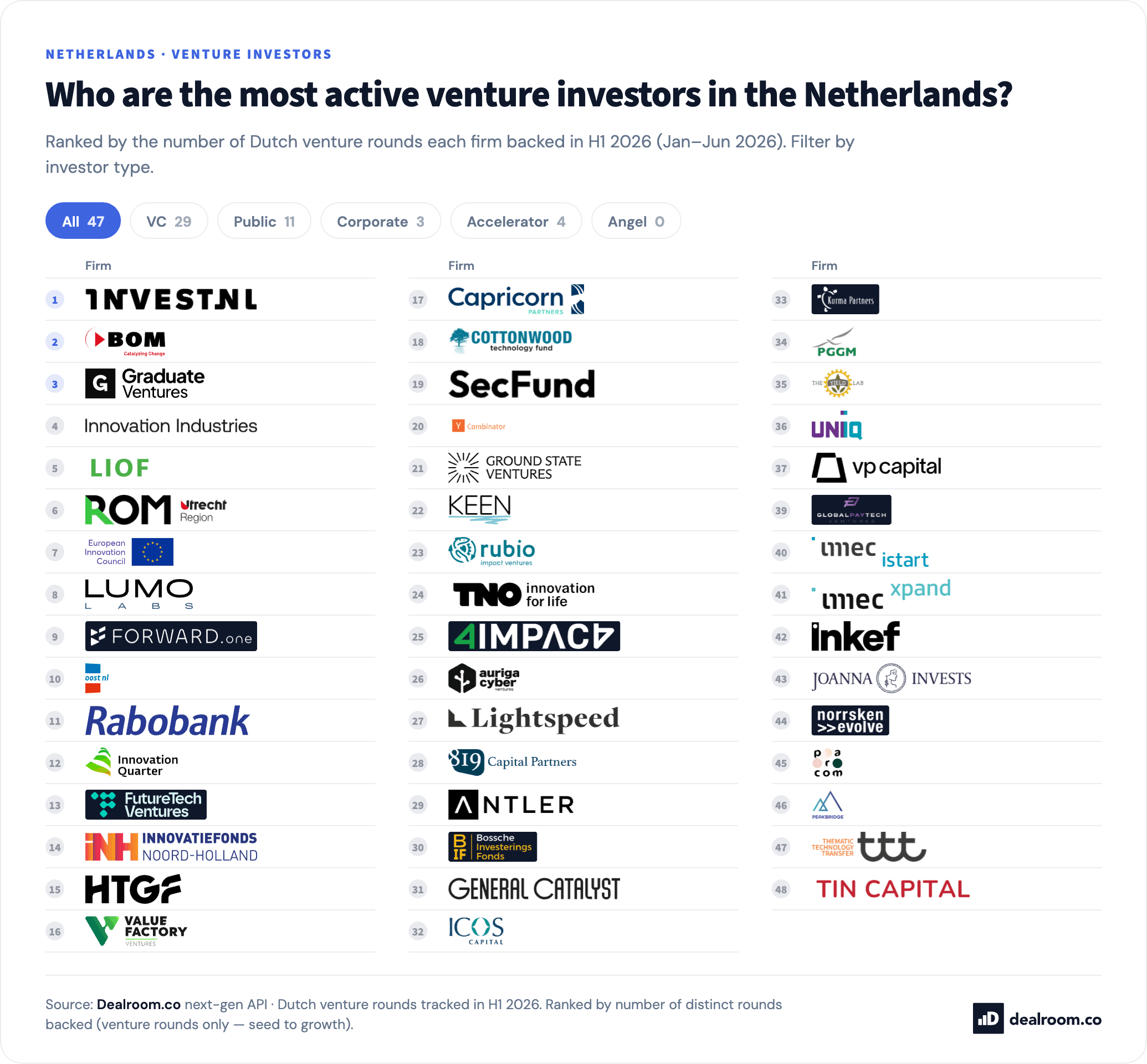
This week several Dutch public funds noted, with some pride, that they were once again among the most active venture investors in the Netherlands in the first half of 2026. One of them asked the fair question: how come? The answer given was a good and honest one. Years of building specialist teams, a fund-of-funds strategy, and a steady stream of people who went on to private funds and to startups of their own. I believe all of it. I run a private fund that invests at inception, so I have a side in this, I can’t pretend that I do not. I still think the ranking they are proud of is the thing the rest of us should be worried about.
Start with what public capital is for, because there is real work here and some of it is genuinely hard. Two kinds of investments in particular. The first is first-of-a-kind deep tech, the factory-scale projects where hundreds of millions ride on binary technical risk and no rational private investor should be willing to go first. The second is the long-horizon bet in areas like health and energy, where the science is sound and the returns are real but the timelines run longer than private patience allows. In both, the right move for a public fund is to come in behind or alongside a private lead and carry the weight that private capital cannot carry on its own. That is additionality, and I have no objection to it.
Everything else is a question of direction, and the direction is the whole argument.
The healthy structure is that private capital picks first. It chooses the company, sets the price, and takes the risk of being wrong with its own money, which is the expensive and information-bearing act. Public capital then comes in behind to derisk that pick and pull even more private money in with it. That is what crowding in means. It runs from private to public.
The invitations I read this week run the other way. “Private investors are welcome to co-invest alongside us”. Read the last two words. It carries an implicit assumption that the public fund is the one who picked, and that private money is the passenger. When the picker is an institution whose failure condition is undeployed capital, its choice carries less information than a private one, because it had to deploy and you did not. Private money that follows that lead is not being crowded in. It is being anchored to a selection made under a mandate to spend.
Now look at what the ranking actually measures. It counts distinct rounds backed. It is a breadth number, not a capital number, and breadth is exactly what is contracting. In the first quarter of 2026, Dutch startups raised just under a billion euros across seventy-two deals, the fewest since 2020. Almost all of that money went to the top: the largest rounds, one deal in five, took more than four fifths of the capital. And the thinning is sharpest at the very bottom. Pre-seed rounds, those under a million euros, made up 12.7 percent of Dutch deals this quarter, against 24.4 percent a year earlier. That share nearly halved in twelve months, and it is the exact point at which companies are first chosen. Private capital is not disappearing. It is moving upmarket, into the large late rounds, and away from the early stage where the picking happens. These are not the factory bets or the long-horizon health and energy rounds where public money belongs. They are ordinary early-stage rounds, the ones private used to lead. As private vacates that layer, public capital becomes the most active investor in what is left of it.
That is why the list should worry the people at the top of it. A public fund leading the activity ranking is not a sign that the ecosystem is well funded. It is a sign that private capital has stopped doing the early picking, and that the state is filling the vacuum by default. The same funds say they want the private industry to grow faster. By that measure, topping this list is not a win.
Someone has to pick first, with their own conviction and their own downside, or there is nothing real for public capital to stand behind.
Genuinely a great insight
I agree, the ranking isn't wrong so much as it measures the only thing that's easy to measure, and everyone then treats it as a proxy for quality.
I think instead break down the data into three parts: which firm led the round, which firms joined, and who wrote the company's first institutional cheque. Track the actual euros invested. Next, for each round a firm led, check how many later attracted a private lead.
Plot ‘how often you go first’ against ‘how often private money followed you.’ That tells you who's catalyzing and who's just deploying. Deal count alone does not reveal this. Obviously this needs dealroom data, KvK filings, and a bunch of hand-cleaning the data.