
You’re targeting the wrong circle
Where the raise actually starts

If you’re raising a fund, the advice is everywhere. Build your newsletter. Post consistently. Let AI send five hundred personalized LinkedIn messages to family offices you’ve never heard of while you sleep.
It’s not wrong, entirely. It’s also not aimed at the right people.
The past few months, I was part of Embracing Emergence’s Fund circle. A cohort of about fifteen emerging managers from across the US and Europe. It functions as an anti-accelerator of sorts, deliberately slow, deliberately introspective. The premise is that most first-time managers skip a step: they start fundraising before they’ve worked out why they’re doing this, what they actually believe, and who they’re building the fund for. The program creates the conditions to stop and answer those questions before the pitch starts. What emerged from that process, for me and many others in the cohort, was a clearer picture of who already believes in you and why. Which brought the LP question in sharper focus.
When you map the ecology of a fund, three rings emerge. The inner ring is Believers—former colleagues, operators you’ve backed, close advisors, HNWIs who watched you work. These people don’t need convincing, anymore. The middle ring is Connectors—people embedded in communities where your LPs already live, who can vouch for you in rooms you’re not in. And the outer ring is Observers. The cold LP universe, the family offices you’ve seen on lists but never met, the Fund-of-Funds who get fifty cold inbounds per week.
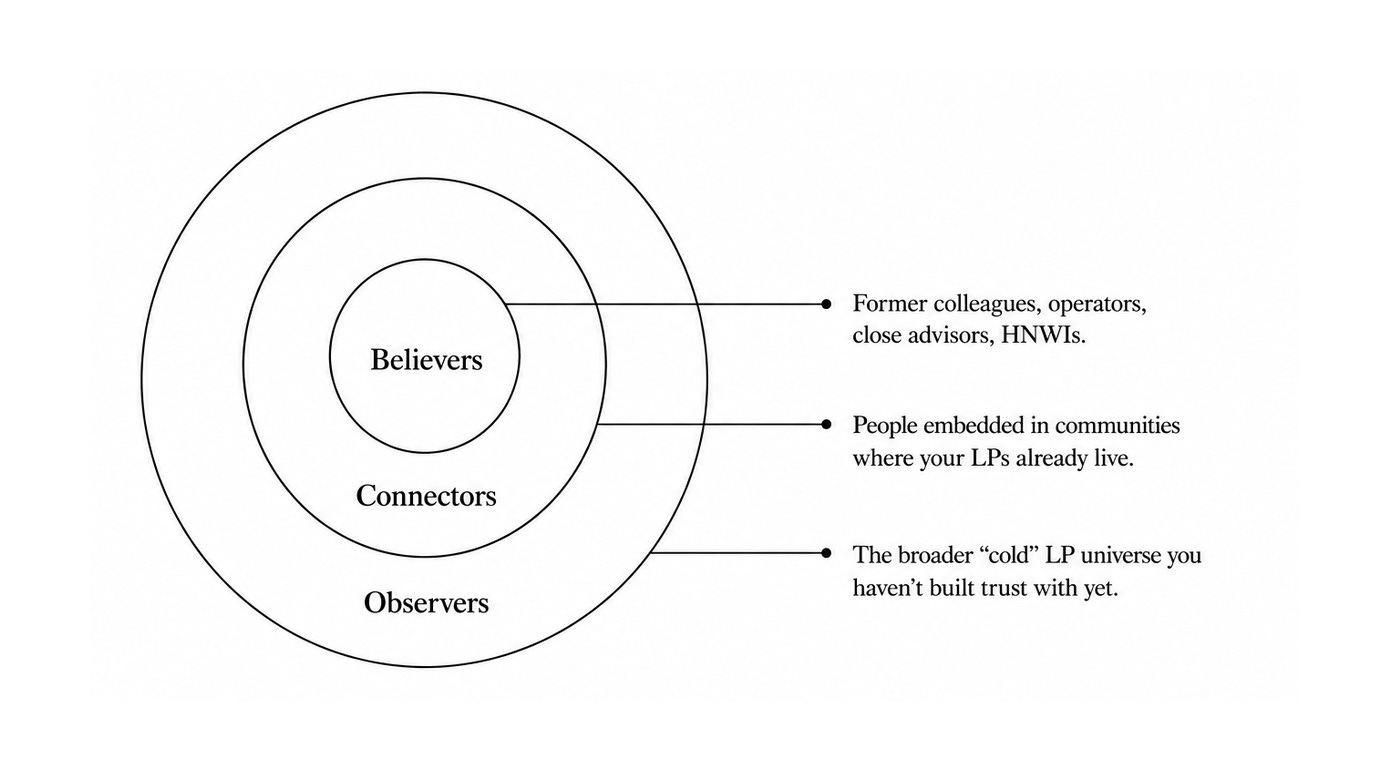
Nearly all LP outreach advice is written for the Observer ring. And here’s the trap. The Observer ring looks so big, that you’d think it’s the opportunity. It’s not. It’s the friction. The Observer ring is where you’ll spend most of your time, but close the least capital. Newsletters convert Observers slowly, if at all. AI outreach converts them, probably, never. And even if the AI slop outreach gets better, every Observer inbox will be automated and the signal-to-noise ratio will be hard to distinguish from spam.
What actually closes a fund is movement between rings. An Observer becomes a Connector when someone they already trust introduces you. A Connector becomes a Believer when they see you operate. A Believer becomes an LP when you ask them.
This is a relational process, not a reach process. And the tactics dominating the advice ecosystem–newsletters, content, AI-personalization–are reach tactics. They’re built for volume. They might work in B2B software sales, where you can close a deal with someone you’ve never met and will never meet again. They don’t work for a ten-year illiquid commitment from someone who needs to trust you as a steward of their capital.
The evidence is right there in how LPs describe what they look for. Nearly every family office says the same thing: they back people they know, or people vouched for by someone they know. Screendoor pairs fund managers with trsuted and experienced advisors because the introduction is the product. Harry Stebbings writes individual emails for each LP not because he’s naive about scale, but because he understands what he’s selling.
We’re asking our LPs for a ten-year illiquid commitment that’s built on their confidence in the judgment we’ll apply over that period with their capital. A well-written newsletter may demonstrate you can write. But the question an LP is actually sitting with is simpler and harder than that: do I trust this person with my capital for ten years? That answer comes from watching somone operate, from introductions made by people they already trust, from conversations that accumulate over time. It doesn’t come from the inbox.
What the Fund Circle surface for me was that the answer was already partially there. People who had watched me work, formed a view, and might say yes if I asked them directly. The program didn’t hand over a fundraising strategy, nor did it provide direct access to LPs. Instead, it created stillness to see what was already there.
good post. newsletters and AI outreach are totally reach tactics. a 10-year illiquid commitment is a trust decision. different sale entirely.